
Few things say “Lowcountry living” like an extra room where you can enjoy the view of your yard. If you are thinking about a sunroom addition in Mount Pleasant, SC, you have likely noticed that the choices overlap. A screened porch, a glass enclosure and a true sunroom can look similar from the street, but they feel very different in August, cost differently to build and are treated differently by the building code. This guide compares the three side by side so you can decide which one fits the way your family actually lives.
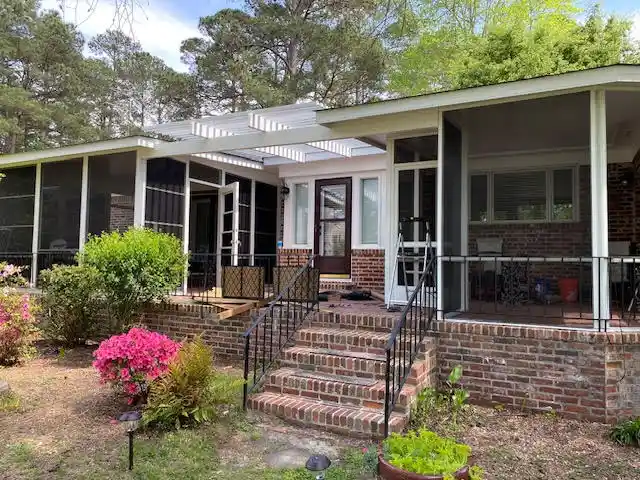
Three options at a glance
- Screened porch: a roofed outdoor space with insect screening instead of walls. It keeps out bugs and direct sun but still lets in breezes, humidity and pollen.
- Glass enclosure: glass or clear panels, often on an existing porch or patio, that block wind and rain while keeping the outdoor feel. It is usually not heated or cooled as part of the house.
- Sunroom or room addition: a fully enclosed, insulated room that is heated and cooled and opens into the home. It works as true living space all year.
How the building code sorts sunrooms
South Carolina enforces the 2021 International Residential Code with state modifications, adopted by the South Carolina Building Codes Council. Section R301.2.1.1.1 of that code requires sunrooms to comply with the AAMA/NPEA/NSA 2100 standard and to be identified in the construction documents as one of five categories:
- Category I: walls that are open or enclosed with insect screening or thin plastic film. Nonhabitable and unconditioned. A screen-walled sunroom fits here.
- Categories II and III: walls enclosed with glass or clear plastic, thermally isolated from the house, nonhabitable and unconditioned. Category III adds air and water resistance requirements for the windows. Many glass enclosures fall in this range.
- Category IV: enclosed, heated or cooled by its own separate system and thermally isolated from the house. Still nonhabitable.
- Category V: enclosed, heated or cooled and open to the main house. This is the only category the code calls habitable and conditioned, which is what most people picture when they say “sunroom.”
Choosing a category early matters. It shapes the wall design, the windows and doors and whether the space counts as living area. The state has also announced its 2024 building codes take effect January 1, 2027, and the Town of Mount Pleasant notes that applications made after that date must be designed to the 2024 codes.
Year-round comfort: heat, humidity and bugs
A screened porch is the most open option. It is a great spot on a spring evening, but in a humid Lowcountry summer it will feel like the outdoors, because it is. Furniture and finishes need to tolerate moisture, and pollen still finds its way in.
A glass enclosure blocks wind and rain and makes the space usable on more days. Because it is unconditioned, though, glass can trap heat on sunny afternoons. Shade, operable windows or screens and the direction the room faces make a big difference.
A Category V sunroom or room addition is built like the rest of your home, with insulation, conditioned air and finished interiors. It is the most involved project, but it is also the only one of the three that works like an extra family room in every season. Homeowners in Goose Creek and Ladson who want a true room addition often land here.
Wind design along the coast
Any of these structures has to stand up to coastal wind. Under South Carolina’s version of IRC Section R301.2.1, homes are built to wind maps approved by the Building Codes Council. The Council-approved Charleston County map draws design wind speed lines at 140 mph and 150 mph, and the local building official confirms the figure for a specific address. Where the code requires wind design, Section R301.2.1.1 calls for an engineered method such as ASCE 7, the AWC Wood Frame Construction Manual or ICC 600. In practice, that affects how the roof ties into your house, how posts are anchored and which windows and doors are rated for the job.
Flood zones and enclosures
If your lot is in a FEMA-mapped flood zone, check it before you design. You can look up your property on the FEMA Flood Map Service Center, and the Town of Mount Pleasant has posted a notice about proposed final FEMA flood map updates. Under federal floodplain rules in 44 CFR 60.3, fully enclosed areas below the lowest floor in A and AE zones may be used only for parking, building access or storage and must have flood openings. In V zones, the space below the lowest floor must stay open or use breakaway walls, lattice or insect screening. An addition can also count as a “substantial improvement” if its cost equals or exceeds 50 percent of the structure’s market value (44 CFR 59.1), which can bring the whole home under current flood requirements.
Permits for a sunroom addition in Mount Pleasant, SC
The Town of Mount Pleasant Building Inspection Division states that its codes require a permit to construct, enlarge or alter any building or structure, and that it reviews plans for additions and renovations. The Town’s Single Family Residential Stormwater Management and Tree Preservation permit also lists additions, decks and screened porches as examples of projects that need it. In the Old Village, the Historic District Preservation Commission reviews all exterior changes, and approval is required before work starts.
Outside Mount Pleasant, the steps vary. A screened porch in Summerville, a glass enclosure in North Charleston or a sunroom on James Island may fall under a town, city or county building department, so confirm your jurisdiction first.
Which option fits your home?
- Choose a screened porch if you mainly want a bug-free outdoor spot for mild months.
- Choose a glass enclosure if you want protection from wind and rain on an existing porch or patio without adding conditioned space.
- Choose a sunroom or room addition if you want true year-round living space that feels like part of the house.
If you are also weighing a separate living space for family, our guide to ADU rules in Summerville, SC explains how accessory dwelling units differ from additions.
Frequently asked questions
Do I need a permit for a screened porch in Mount Pleasant SC?
In most cases, yes. The Town requires permits to construct, enlarge or alter structures, and it lists screened porches among the projects that need its stormwater and tree preservation permit. The Building Inspection Division can confirm what your specific project requires.
Is a sunroom considered living space?
Under the code’s sunroom categories, only a Category V sunroom, which is heated or cooled and open to the main house, is habitable and conditioned. Categories I through IV are nonhabitable.
Searching for a sunroom builder near me in Mount Pleasant or West Ashley?
Intelligent Home Services is based in Summerville and designs and builds sunrooms, screened porches, glass enclosures and additions across the Charleston area, including Mount Pleasant, West Ashley, James Island and Hanahan.
Plan your Mount Pleasant sunroom with confidence
The right choice depends on how you want to use the space, your lot and the codes that apply to your address. Intelligent Home Services can help you compare options and handle the design and permit process. Schedule a consultation or call us at (843) 376-9730.
Areas we serve: Summerville, Charleston, North Charleston, Goose Creek, Hanahan, Ladson, Ridgeville, Moncks Corner, Mount Pleasant, James Island and West Ashley.
Sources: South Carolina Building Codes Council (adopted codes; 2024 codes effective January 1, 2027) and its wind/seismic maps; 2021 South Carolina Residential Code (ICC), Sections R301.2.1, R301.2.1.1 and R301.2.1.1.1; Town of Mount Pleasant Building Inspection Division, Building Code and What’s New pages and Historic District Preservation Commission; 44 CFR 60.3 and 44 CFR 59.1; FEMA Flood Map Service Center. This article is general information, not legal or code advice. Confirm current requirements with your local building department before you build.